
Open Access: Exploring 130 Years of American Design
This work is part of Urban Room, a multi-project initiative; learn more about it here.
Contents 
Opening October 8, this exhibition invites artists and designers to respond to our extensive archive.
About

Open Access: Exploring 130 Years of American Design
On view October 8–November 13
303 Bond Street, Brooklyn
Exhibition hours
Mondays–Thursdays, 10 am–6 pm
Select extended hours
Van Alen Fall Fest: Saturday, October 17, 12–4 pm
Fridays/Saturdays, 12–6 pm: October 23–24 and 30–31, November 6–7 and 13
Van Alen Institute has spent more than 130 years at the intersection of design ambition and civic life. Its archive of thousands of competition boards, jury records, travel logs, and correspondence is one of the most extensive records of American architectural history. But an archive is never neutral. It reflects the priorities, blind spots, and values of those who built it: who was invited in, whose ideas were resourced, and whose were left out entirely.
Open Access brings together artists and design teams to interrogate this record. Working directly with Van Alen’s historic materials, each asks a critical question: what does this archive tell us about who design has historically served, and who has it erased?
From sonic installations summoning uncredited voices to core samples grounding architecture in land history, these works treat the archive as living material — something to be questioned, reinterpreted, and held accountable. You are invited to explore the exhibition with curiosity and skepticism, knowing the story of who shapes our cities is still being written.
Participants
- Annie Barrett, Daniel Pittman, and Paula Vilaplana de Miguel
- Kholisile Dhliwayo
- Friends Making Work
- PROPS SUPPLY
- Gillian Waldo
Exhibition team
- Exhibition design: NOT NOT
- Graphic design: Studio Loutsis
- Fabrication: Kurt Brosnan, East Hill Digital Fabrication
This exhibition is made possible by the National Endowment for the Arts and the Graham Foundation for Advanced Studies in the Fine Arts. Material support is provided by METALSISTEM, TALAS, K-array, Qualia Forge, Sharp, and TAD.
Projects
Haunting Van Alen’s Archive

For more than a century, Van Alen’s archive has recorded who was invited in: who competed for the Paris Prize, who sat on juries, who shaped a brief, who attended the Beaux-Arts Ball. But an archive of access is equally an archive of exclusion. Every name preserved implies others who were never entered, never credited, never asked.
Haunting Van Alen’s Archive approaches the archive through that absence, treating haunting as a method of making the structurally invisible appear. These missing people are reanimated as spectral projections in Van Alen’s windows, visible only after dark when the institution is closed. Inside, a sound installation is triggered as visitors move through the space, giving voice to archival fragments, reconstructed testimony, and the atmosphere of past Beaux-Arts Balls. The project reclaims the ghost as a tool for questioning established narratives, revealing that the people excluded from design institutions were always already present.
Artists

Annie Barrett
Founding Principal, Aanda Architects

Daniel Pittman
Partner, TAD

Paula Vilaplana de Miguel
Designer, Creative Director, and Curator
Re-grounding the Archive

Where is the ground in architectural and urban representation? Re-grounding the Archive opens up Van Alen’s history to an archeological examination of its institutional attitudes towards the ground, land, environment, and the city over time. Through a series of speculative “core samples” made of paper pulp and clay, these tactile artifacts are encoded with various attitudes toward the ground.
Each “core” references competition proposals at a various moment in the institution’s identity, particularly projects that articulate a position toward the ground. Heeding sociologist Bruno Latour’s call to bring climate change politics “down to earth,” Re-grounding the Archive examines how the archive has represented (or not) architecture’s relationship to the ground over the last 100 years. Visitors are invited to handle the core samples, read them as material indexes of the archive, and have conversations about the institution’s layered history.
Artists

Christine Giorgio
Co-Founder, Friends Making Work

Amelyn Ng
Co-Founder, Friends Making Work

Gabriel Vergara
Co-Founder, Friends Making Work
Survival — A World Ecological Study Centre

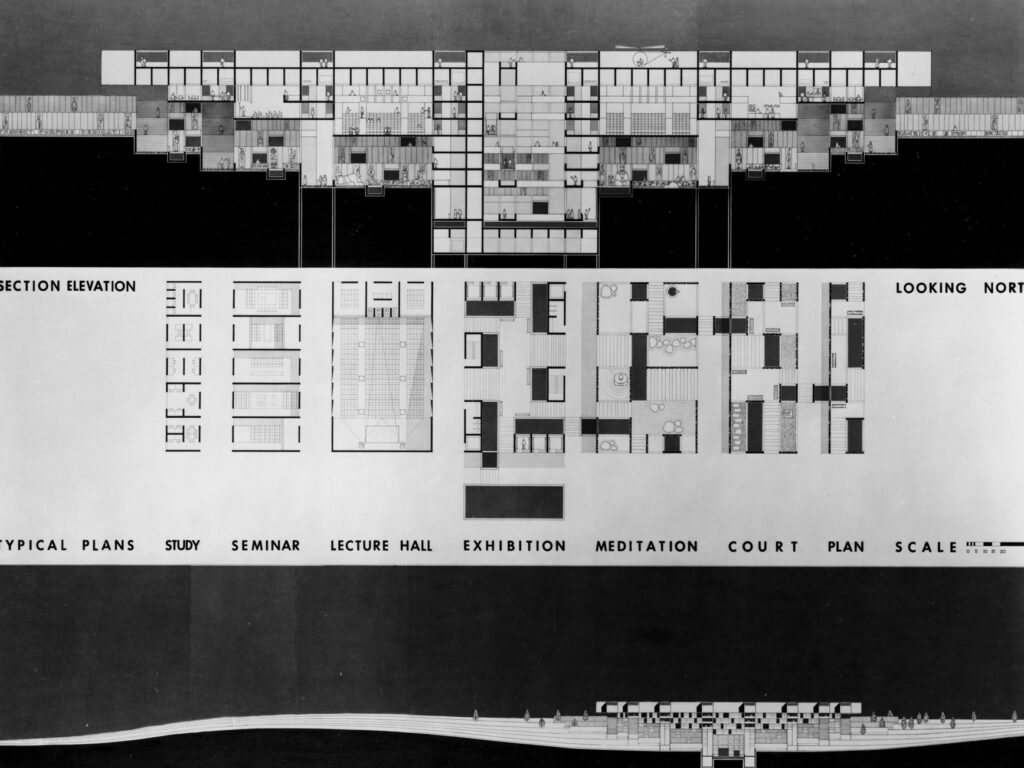
A 1973 Van Alen competition tasked architects to design an ecological center dedicated to “the research required to institute a system of monitoring and control of the World’s environment.”
Survival — A World Ecological Study Centre surveys the cultural and political context in which the original competition was conceived, examines the environmental optimism of the early 1970s and traces the emergence of ecological thinking as a design program. The project also includes a new architectural response to the original competition brief as a demonstration of alternative strategies today.
Artists

Matthew Bohne
Co-Founder, PROPS SUPPLY

Lucy Siyao Liu
Co-Founder, PROPS SUPPLY
Western Pattern Language

The language contained in competition briefs and entries of the Paris Prize in Architecture is revealing of how some architects viewed the United States’ role in the world: The colonization, domination, or obliteration of others is often implicit in these descriptions.
Western Pattern Language draws attention to this grammar through three CRT monitors displaying imagery and text from documents and entries of the Paris Prize in Architecture. Visitors can also directly interact with these source materials at an accompanying microfiche station. The project asks us to understand the resulting forms as extensions of the state, reflect on the current built environment, and consider the role architects play in furthering the objectives of state power.
Artist

Whose Land Are You On?

If there is only one thing that comes of this exhibition, I hope it is that you ask the next ten people you speak to whose Indigenous lands they live on, and where the governments of those nations are located now.
— Kholisile Dhliwayo
Whose Land Are You On? places Van Alen’s archival competition briefs and winning entries alongside contemporaneous political legislation and activist materials such as protest posters. Contending with archival material from the last century begs the questions: How are we engaging — and can we better engage — with issues of restitution, sovereignty, and spatial justice? Most importantly, how can we be in relationship with the Indigenous Nations and Peoples on whose land we live and work?
Artists

Kholisile Dhliwayo
Artist, Architect, and Curator
Events
October 19, 2026
The Architectural Anarchive: Reimagining the Design Archive
Shannon Mattern (Metropolitan New York Library Council) leads a discussion around how archives determine what’s worthy of collection and preservation, and the role of the architectural archive in an age of extractive technologies.

October 22, 2026
The Accidental Archive: A Community Workshop
Writer and artist Divya Mehra leads an interactive workshop to explore our own personal archives, asking questions about the value of the mundane and what it means to embrace our own archival practice.
October 29, 2026
An Archival Séance with Marina Otero Verzier
Architect and researcher Marina Otero Verzier, in collaboration with Paula Viliplana de Miguel, conducts a seance-inspired performance that tunes into the spirits of those not present in the archives.

Curators


Supporters


Related Projects
Van Alen Archives
